Crawlspace pest barrier and moisture exclusion stops chronic pest activity by correcting the sub-structural physics that attract organisms into residences. In historic river-bluff neighborhoods like Rivermont, Diamond…
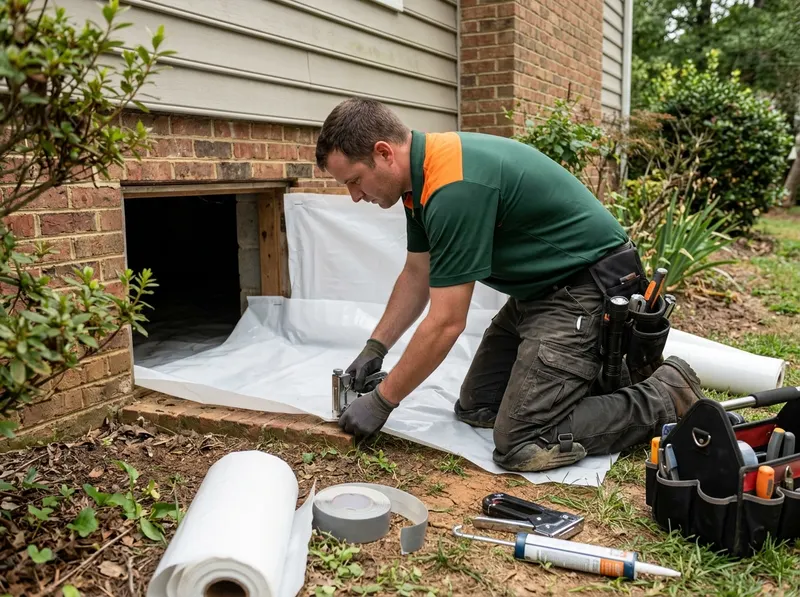
Crawlspace pest barrier and moisture exclusion stops chronic pest activity by correcting the sub-structural physics that attract organisms into residences. In historic river-bluff neighborhoods like Rivermont, Diamond Hill, and Federal Hill, older rubblestone and unreinforced masonry foundations permit moisture migration directly from saturated soils. High humidity creates an ideal environment for Reticulitermes flavipes (eastern subterranean termites) and Sprinkled Camel Crickets, which thrive in environments where subfloor wood moisture content exceeds 19 percent. Conventional pest management relies on recurring interior chemical sprays that target adult insects while leaving the underlying moisture reservoir intact. Mechanical exclusion removes this survival vector by laying reinforced poly sheeting across 100 percent of exposed dirt, taping foundation piers, and sealing sill-plate gaps against outdoor pest reservoirs.
In newer slab-adjacent and crawlspace developments around Wyndhurst, Cornerstone, and Fort Hill, the primary structural failure stems from foundation penetrations around plumbing drop-ins, HVAC trunk lines, and perforated foundation vents. Mice require an opening of only 0.25 inches (6 millimeters) to breach a foundation wall; rats require 0.5 inches (12 millimeters). Standard foam sealant is inadequate because rodents easily gnaw through cured polyurethane. Crawlspace moisture exclusion integrates 19-gauge hardware cloth and copper-mesh packing behind elastomeric sealants at every utility penetration, forming an impassable physical shield. In high-water-table zones near Timberlake and parcels sloping toward the James River or Blackwater Creek, soil evaporation loads the crawlspace with airborne water vapor that condenses on subfloor joists. Installing heavy-gauge ground vapor barriers directly arrests this evaporation, preventing fungal rot (Coniophora puteana) that softens structural lumber and invites destructive wood-boring insects.
Homeowners selecting between continuous chemical bait systems and physical exclusion must evaluate long-term maintenance against upfront capital expenditure. Chemical termiticide treatments create a soil boundary around the perimeter footing but do not prevent rodent nesting, cricket proliferation, or fungal wood deterioration beneath the subfloor. A continuous 12-mil to 20-mil sealed crawlspace barrier mechanically separates the living space from the soil, preventing subterranean species from ascending foundation footings undetected. When soil moisture drops below 15 percent, pest populations naturally abandon the substructure. Work begins by contacting (804) 807-9933 to arrange a baseline moisture-content reading and structural gap assessment.
Every job gets a firm, written price after a free on-site visit.
Tell us about your crawlspace pest barrier and moisture exclusion job in Lynchburg and we'll send a clear, written quote, usually the same day.
 Quervia Pest Elimination